



MICHAEL ARNOLD ART
|
"Rock Through the Ages" Visit our " Rock Through the Pages", an encyclopedia of facts, photos and videos of each of the artists in this original painting. |
|
|
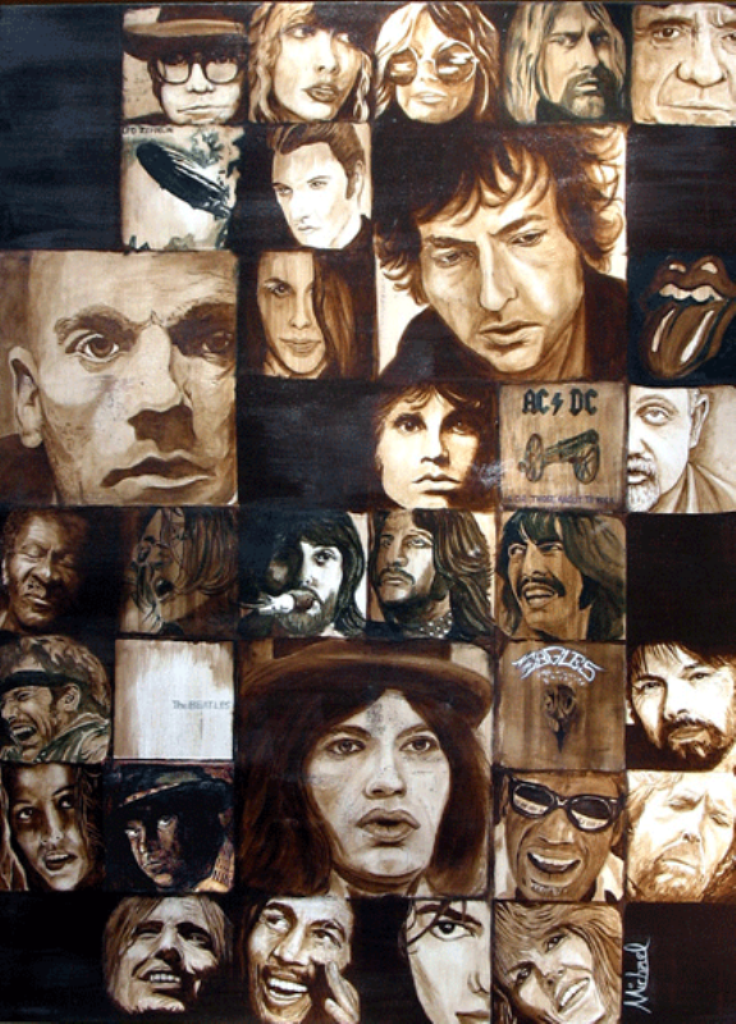
“Rock Through the Ages” is an
original, signed acrylic painting on a gallery-wrapped canvas by artist Michael
Arnold. I wanted to paint a picture of some of my favorite musicians. The
painting evolved in sketches over several months before I began the painting.
However, once I started the painting I changed course several times over the six
months it took to complete it. Many of the musicians I wanted to include had to
be left out. This subject begs for a series. The musicians, from top left, are:
Elton John,
Stevie Nicks,
Janis Joplin,
Kurt Cobain,
Johnny Cash,
Led Zeppelin,
Elvis,
Bob Dylan,
The Rolling Stones,
Michael Stipe,
Alanis Morrisette,
Jim
Morrison, AC/DC,
Billy Joel,
Chuck Berry,
John Lennon,
Paul McCartney,
Ringo
Starr, George Harrison,
Bruce Springsteen,
The Beatles,
Mick Jagger,
The Eagles,
Bob Seger,
Sheryl Crow,
Neil Young,
Ray Charles,
Eric Clapton,
Tom Petty,
Bob
Marley, Michael Jackson and
Lucinda Williams.
The painting makes a bold statement on any wall where it is displayed.
"Rock Through the Ages" is also available as the front of
note cards and the prints can be purchased
here.
This artwork was created using acrylic paint on a high quality wrapped
canvas. Acrylic paint works very well on stretched canvas. When
purchasing artwork many people aren't sure what the difference is
between acrylic and oil paintings. The main difference between acrylics
and oil paints is the inherent drying time. Oils allow for more time to
blend colors and apply even glazes over underpaintings. This slow drying
aspect of oil can be seen as an advantage for certain techniques, but in
other regards it impedes the artist trying to work quickly. The fast
evaporation of water from the acrylic paint film can be slowed with the
use of acrylic retarders. Retarders are generally glycol or
glycerin-based additives. Oil paints tend to require the addition of a
toxic solvent, such as mineral spirits or turpentine to thin the paints
and clean up tools, though relatively recently water soluble oil paints
have been developed for artist use. Secondly, oil paint films become
increasing yellow and brittle, and will lose their flexibility in a few
decades. Acrylics can be used on many surfaces without a medium- layer.
They allow sharp brush-strokes but also a more delicate shading,
although it is more difficult to create a smooth change between
different shades. They are usually very bright. Although the permanency
of acrylics is sometimes debated by conservators, they appear more
stable than oil paints.
|
|
|
|
|
|
![]()